Wednesday, May 6, 2009
Day 320: Unstable element

Tuesday, May 5, 2009
Day 319: The big 3

Monday, May 4, 2009
Day 318: Magical thoughts

san andreas fault, photograph by Robert E. Wallace, USGS.
Later, after I married and had a child, I learned to find equal meaning in the repeated rituals of domestic life. Setting the table. Lighting the candles. Building the fire. Cooking. All those souffles, all that creme caramel, all those daubes and albondigas and gumbos. Clean sheets, stacks of clean towels, hurricane lamps for storms, enough food and water to see us through whatever geological event came our way. These fragments I have shored against my ruins, were the words that came to mind then. These fragments mattered to me. I believed in them. That I could find meaning in the intensely personal nature of my life as a wife and mother did not seem inconsistent with finding meaning in the vast indifference of geology and the test shots; the two systems existed for me on parallel tracks that occasionally converged, notably during earthquakes. -- from Joan Didion's The Year of Magical Thinking
Sunday, May 3, 2009
Day 317: Poetic intervention

Saturday, May 2, 2009
Day 316: To the dunes

Two weeks from today we'll be back in the dunes. A surprise opening has occurred and we have been granted one glorious week in a dune shack through Provincetown's Peaked Hill Trust. We couldn't be more blissed out in response.
Friday, May 1, 2009
Day 315: Meeting the energy

a clip from my letter
Thursday, April 30, 2009
Day 314: Mythical west

Cindy Sherman. Untitled Film Still #43, 1979. Gelatin silver print. 7 9/16 x 9 7/16” (19.2 x 24cm). The Museum of Modern Art, New York. Acquired through the generosity of Sid R. Bass. © 2008 Cindy Sherman
On Monday we saw Into the Sunset: Photography's Image of the American West at the MoMA. It was a fascinating show, yet oddly didn't offer much in response to contemporary land-use. This omission (including the nuclear) seems to perpetuate some of the very myths that the show was trying to visualize.
Wednesday, April 29, 2009
Day 313: All in relation

I just completed my Flash II class (yipee! one step closer to summer!) and the weeks of coding are starting to materialize. The first resulting project is a new gallery for Liz's photography. Check it out here.
Tuesday, April 28, 2009
Day 312: Mono no aware

"Mono no aware (物の哀れ ,mono no aware, lit. "the pathos of things"), also translated as "an empathy toward things," or "a sensitivity of ephemera," is a Japanese term used to describe the awareness of mujo or the transience of things and a bittersweet sadness at their passing. The term was coined in the eighteenth century by the Edo-period Japanese cultural scholar Motoori Norinaga, and was originally a concept used in his literary criticism of The Tale of Genji, and later applied to other seminal Japanese works including the Man'yōshū, becoming central to his philosophy of literature, and eventually to Japanese cultural tradition".
- read more
Monday, April 27, 2009
Day 311: The search is on

We'll be extending cards again on our upcoming atomic journey through the west/southwest - this time with a Proustian/geologic twist. A sample graphic is included above.
Sunday, April 26, 2009
Saturday, April 25, 2009
Day 309: Equality
My friend Fred is not only a (most amazing) massage therapist, he's also an incredible activist. Spread the word!
Friday, April 24, 2009
Day 308: Immokalee

still from Immokalee, copyright Small Gauge Films 2009
Kevin, Jen and Kim have a new film in the works. Check out this most amazing work in progress.
Thursday, April 23, 2009
Day 307: Superflat

the playa and Old Razorback Mountain in the Black Rock Desert
Here is a more populated desert scene, putting the flatness to the test.
Wednesday, April 22, 2009
Day 306: Winged words

image bbtb
My sister offered up this line of flight yesterday:
Tuesday, April 21, 2009
Monday, April 20, 2009
Day 304: Improbable cap

Credit: Defense Special Weapons Agency
"Beneath this concrete dome on Runit Island (part of Enewetak Atoll), built between 1977 and 1980 at a cost of about $239 million, lie 111,000 cubic yards (84,927 cubic meters) or radioactive soil and debris from Bikini and Rongelap atolls. The dome covers the 30-foot (9 meter) deep, 350-foot (107 meter) wide crated created by the May 5, 1958, Cactus test. Note the people atop the dome."
The U.S. Nuclear Weapons Cost Study Project was completed in August 1998 and resulted in the book Atomic Audit: The Costs and Consequences of U.S. Nuclear Weapons Since 1940 edited by Stephen I. Schwartz.
Read more at the Brookings Institute
Sunday, April 19, 2009
Day 303: Earthly contact

Vicente Guallart
I love this image and have posted it for no reason other than to increase the possibility of encountering a "natural" object while participating in a virtual environment.
Friday, April 17, 2009
Day 302: Making change

Basin and Range extension from Jacques Angelier


Mick Meader offers a Basin and Range demonstration
Day 301: Vast Extension
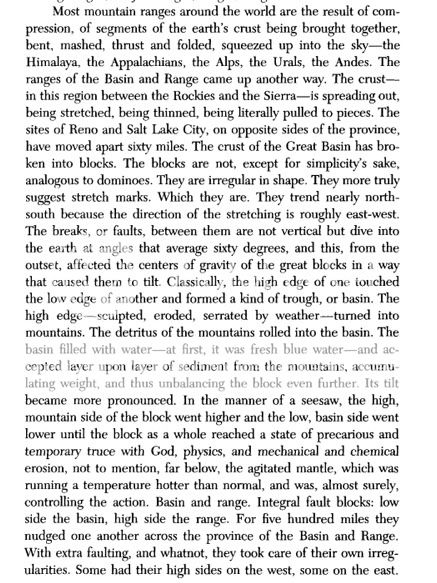
page 46 of John McPhee's Annals of the Former World, from Basin and Range
Thursday, April 16, 2009
Day 300! SHIFT of energies


5th avenue today
Wednesday, April 15, 2009
Day 299: Diego Garcia

This image is a work of a U.S. military or Department of Defense employee, taken or made during the course of an employee's official duties. As a work of the U.S. federal government, the image is in the public domain.
This might look like another idyllic island from the air, but on the ground it is a different story. Diego Garcia is located in the Indian Ocean, about 1,000 miles south of the southern coast of India.
Tuesday, April 14, 2009
Day 298: Post-Terrestrial

roadcut in PA, 2009 (click to enlarge)
If you are around, seats might still be available. Learn more on the SVA site.
Monday, April 13, 2009
Day 297: Inner city
Sunday, April 12, 2009
Day 296: Third space

Tom Marioni, Running and Jumping with a Pencil Marking the Paper While Trying to Fly, 1972
View the online exhibition on the Guggenheim website.
Saturday, April 11, 2009
Day 295: Thinking Free

Eugene Richards for The New York Times
On March 25th, the New York Times Magazine ran an extended story about legendary physicist Freeman Dyson. With good reason, the 85 year old scientist is still making the news. I've referenced him multiple times on this blog in the past (see Day 230 and Day 50). This most recent article is an update on where the man and his mind and work are focused now- the topic of global warming. Seemingly always at the edge of controversy, Freeman still lives up to his legend with far-flung ideas and imaginations in response to topic that seems undeniable desperate and material at this point, "Dyson says he doesn’t want his legacy to be defined by climate change, but his dissension from the orthodoxy of global warming is significant because of his stature and his devotion to the integrity of science. Dyson has said he believes that the truths of science are so profoundly concealed that the only thing we can really be sure of is that much of what we expect to happen won’t come to pass. In “Infinite in All Directions,” he writes that nature’s laws “make the universe as interesting as possible.” This also happens to be a fine description of Dyson’s own relationship to science. In the words of Avishai Margalit, a philosopher at the Institute for Advanced Study, “He’s a consistent reminder of another possibility.” When Dyson joins the public conversation about climate change by expressing concern about the “enormous gaps in our knowledge, the sparseness of our observations and the superficiality of our theories,” these reservations come from a place of experience. Whatever else he is, Dyson is the good scientist; he asks the hard questions. He could also be a lonely prophet. Or, as he acknowledges, he could be dead wrong."
Read more in the Times.
Friday, April 10, 2009
Day 294: Field encounters

Image: Oficina Salitreria Properidad, Chile, 12 Oct 2007 by Chris Taylor (Land Arts of the American West)
A lot had changed since May of 2007! We have collaborated with the New Mexican contingent of the Land Arts of the American West program this past fall, and will again this summer and next fall. We might even end up meeting up with them out in the field next October. We also are very much looking forward to seeing Chris again today, in New York for his talk at Parsons. He'll also be at Yale next Monday if you are in the area.
The low down on the conversation follows below, we couldn't be more intrigued and inspired by the content. Oh yeah, the Land Arts program also just published a book, check it out and place advanced orders!
RECLAMATION OF POST-INDUSTRIAL TERRITORIES:
LAND ARTS AND THE INCUBO ATACAMA LAB
Friday, 10 April 2009, 2:00-4:00pm
Parsons The New School for Design
Aronson Gallery, 2 West 13 Street, 1st floor, New York, NY 10011
This event will address the reclamation of post-industrial landscapes, environmental impact of the practices of reclamation, and roles that architecture, art and design play in such processes. The panel will further discuss the field methods of Land Arts of the American West, and the Incubo Atacama Lab in Chile, as a case study. Joel Towers, Dean of the School of Design Strategies, and an Assoc. Professor of Architecture and Urban Ecology at The New School, will frame the panel by discussing the epistemological significance of post-industrial landscapes within the framework of Urban Ecology, and also the environmental impact of reclamation.
Land Arts of the American West at Texas Tech, directed by Chris Taylor, is a field program that investigates the intersection of geomorphology and human construction beginning with the land and extending through the complex social and ecological processes that produce contemporary landscapes. The Incubo Atacama Lab project began when the curatorial exchange organization Incubo invited Chris Taylor to bring the working methods of Land Arts to Chile. The lab brought together a group of students and researchers from North and South America for a conference in Santiago and fieldwork in the Atacama Desert to examine earthworks and create contemporary responses to the industrial use of land over time. Panel respondent will be Carin Kuoni, Director of the Vera List Center for Art and Politics, The New School, who will also moderate the discussion.
Thursday, April 9, 2009
Day 293: Blank Spots

Read some review of the book, from Mother Jones or TIME.
You can even buy a copy through the Military Book Club.
Wednesday, April 8, 2009
Day 292: A world without

the first generation of North Korea's ballistic missile, the second generation was tested this week. from mailonline.
Yet, what might come of the existing nuclear waste still seems completely up in the air...
Obama has reduced support for the Yucca Mountain Project, which would be the nation's first high-level nuclear waste repository. Read about the controversy of defunding the project in the Bulletin of Atomic Scientists.
Tuesday, April 7, 2009
Day 291: A little bit greener

my dad, photo by Jan Kruse
I hope today's voter turn out rises up to meet the energy extended by him, and all the other Greens, that all the hard work, dedication, and energy expended to get to this day can be celebrated and recognized by many. I know I will be pausing to acknowledge his incredibly brave and creative actions from New York today and look forward to planning my parents month long summer retreat in the Park Slope tomorrow.
Happy Election Day to all!
Learn more about the national Greens here.
Monday, April 6, 2009
Day 290: Hooked
at the end of columbia street in red hook, looking towards the neighborhood (click to enlarge)
Good news! The open studios for Red Hook are scheduled for May 30-31st, so mark your calendar for stopping by and help celebrate and "warm up" our studio with us. More details in the coming weeks.
Sunday, April 5, 2009
Day 289: Plume

I wrote back on Day 224 that the eruption of Mount Redoubt was imminent. The volcano emitted a plume of ash on March 15th, 2009 and has been erupting intermittently since. The Times's coverage has been interesting, only coming in the form of flight cancellation updates, short reprints of AP stories, fear-inducing ash warnings, or when parallels can be made with "eruptions" within the political scene of Alaska. The newspaper still doesn't seem to have found reason to directly addresses the event as news in itself, as a source of wonder, and definitely nothing that gives the eruption a broader context within environmental understanding or planetary geologic history.
If you want to experience any of this for yourself, enjoy some amazing photos here.
Or, you can even follow along on Twitter.
Saturday, April 4, 2009
Day 288: Support the arts

smudge studio on the LAND/ART website
Friday, April 3, 2009
Day 287: Tapped to the source

Fly Geyser, from Wikipedia
Thursday, April 2, 2009
Day 286: Postopolis

Postopolis is "a live 5-day blogathon of back-to-back discussions, interviews, panel talks, slideshows, films and parties with scheduled and unscheduled guests, themed around landscape and the built environment."
Check out and experience the amazing list of thinkers and doers speaking LIVE from L.A. for the next several days. Enjoy!
Wednesday, April 1, 2009
Day 285: Much to work with
images from our time at Penn State
Tuesday, March 31, 2009
Day 284: Riparian zone

from Clemens Park North Fork
Monday, March 30, 2009
Day 283: Ecotone

image: appalachian voice
Sunday, March 29, 2009
Day 282: Obelisk

checking out the rocks at Penn State
During our time at Penn State we encountered the obelisk.
Saturday, March 28, 2009
Friday, March 27, 2009
Day 280: Desert Islands Part V

Manahatta Island Manhattan Island (click to enlarge)
copyright Mark Boyer and Wildlife Conservation Society and the New York Times
The fifth and final excerpt posted from Gilles Deleuze's Desert Islands.
(Read Part I on Day 258 and Part II on Day 262, Part III on Day 263, Part IV on Day 277)
Thursday, March 26, 2009
Day 279: Spirit rock

obsidian for Robert
It can absorb anger, fear, and stress. It can also be used for clear vision and to insight into the future.
It is associated with Pluto - Greek god of the underworld and keeper of hidden treasure. It is a grounding stone but also contains a fiery element. It is useful for developing the strength needed to stand on your own convictions against any enemy (hidden or otherwise). Obsidian helps to protect the very sensitive against depression. It is the stone of the soft hearted and gentle people of the world. Use obsidian to help block negativity of any kind. As a black gemstone, it symbolizes self control and resilience. Black stones have protective energies in the sense that black is the absence of light, and therefore, can be used to create invisibility.
Wednesday, March 25, 2009
Day 278: Generating

poster promoting Elizabeth's talk tomorrow afternoon (I take photo credit for the image)
Tuesday, March 24, 2009
Day 277: Desert Islands Part IV
.jpg)
Robinson Crusoe Island
The fourth of 5 excerpts to be posted over time from Gilles Deleuze's Desert Islands.
(Read Part I on Day 258 and Part II on Day 262, Part III on Day 263)
Monday, March 23, 2009
Day 276: 1000 polaroids

image of installation from David Zwirner Gallery
Seen alongside Polaroids from some of diCorcia’s most recognized bodies of work and distinctive series – Hustlers, Streetwork, Heads, Lucky Thirteen – are intimate scenes with friends, family members, and lovers; self portraits; double-exposures; test shots from commercial and fashion shoots; the ordinary places of everyday life, such as airport lounges, street corners, bedrooms; and still life portraits of common objects, including clocks and lamps."
Sunday, March 22, 2009
Day 275: Site-ing

Agnes Denes (b. 1938). 'Isometric Systems in Isotropic Space—Map Projections: The Snail', 1979. Whitney Museum of American Art.